Archival Systems & Cultural Preservation
Preservation pipelines that keep human memory readable forever
From the moment an artifact is captured to the century it is still being consulted, our systems handle storage, integrity, indexing and public access — built on the OAIS reference model and trusted by national collections.
Long-Term Cloud Storage
The lifecycle of a preserved artifact
Every object in a Willow Sanctum repository follows a disciplined, auditable lifecycle — the heart of our OAIS-compliant cloud storage pipeline.
-
01
Ingest & Appraisal
SIP packages are validated at the gate: checksums verified, virus-scanned, formats identified against PRONOM, and appraisal rules decide what enters the permanent collection.
-
02
Archival Storage & Fixity
AIPs are written to geographically separated object stores with erasure coding. Continuous fixity audits re-hash every object on a rolling schedule and self-heal any drift.
-
03
Format Migration Watch
Technology watch monitors file-format obsolescence risk. When a format ages, migration pathways produce new AIP versions — originals are never discarded.
-
04
Access & Dissemination
Lightweight DIPs power public portals, IIIF viewers and researcher APIs, so preservation masters stay dark while access copies stay fast.
OAIS-Compliant Archiving
Standards aren't a feature. They're the foundation.
Our repositories implement the ISO 14721 (OAIS) reference model end to end: ingest functions, archival storage, data management, preservation planning and access — with the representation information researchers need to render files 100 years from now.
- Content information & representation information preserved together
- Preservation planning feeds automated technology-watch alerts
- Provenance captured in PREMIS, descriptive context in Dublin Core / MARC21
- Audit-ready event logs for every action on every object
ISO 14721
OAIS reference model
PREMIS 3
Preservation metadata
IIIF
Image & presentation APIs
BagIt
Transfer packaging
High-Resolution Artifact Archival
Rare document digitization frameworks
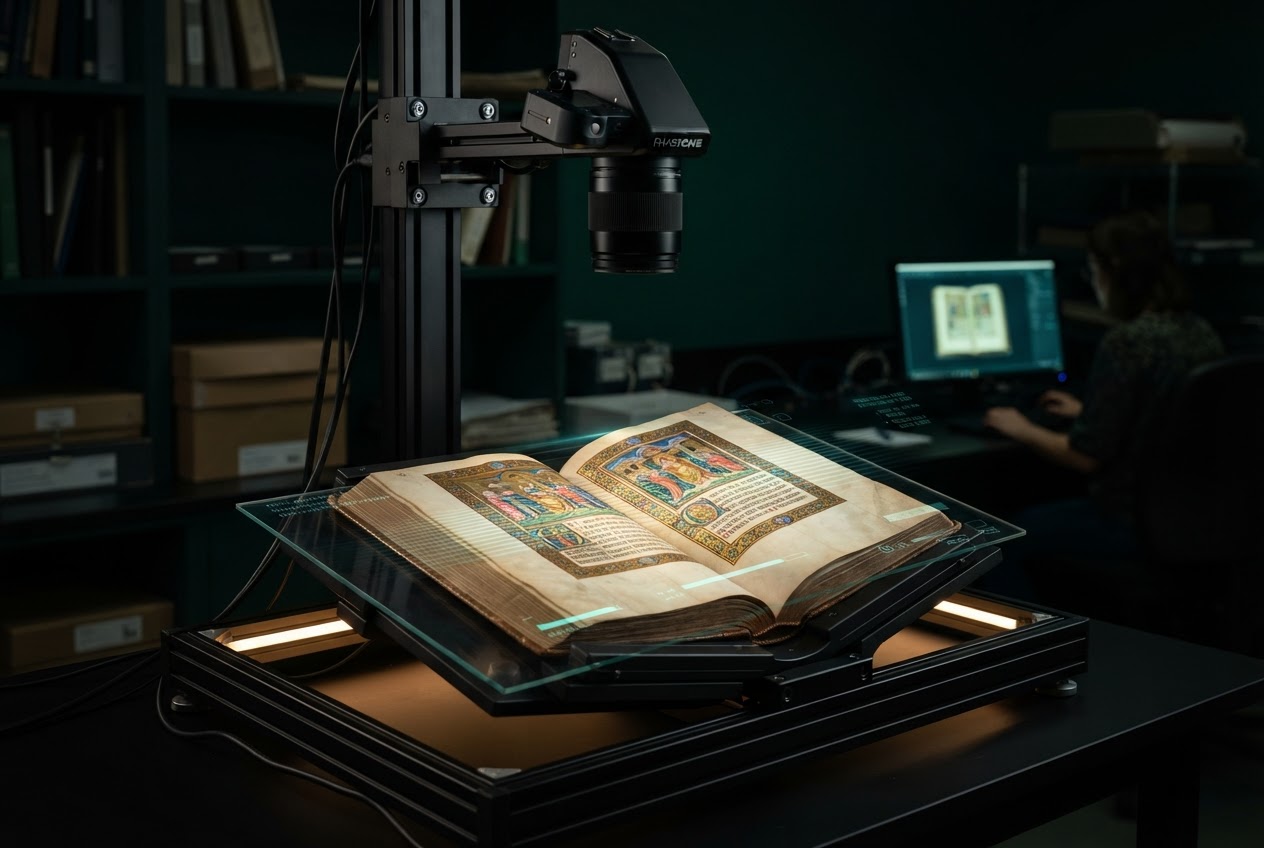
High-definition asset indexing starts with capture discipline. We design digitization frameworks around the fragility of the original and the ambition of the archive — then index every derivative automatically.
- V-cradle and overhead capture rigs for fragile bound volumes
- 600+ PPI master scans with calibrated colour targets (FADGI 4-star)
- Multispectral imaging partnerships for palimpsests and faded manuscripts
- OCR and HTR (handwriting recognition) for full-text search layers
- Audio-visual digitization: reel-to-reel, wax cylinder and film transfers
- Born-digital accessioning from legacy media, email and institutional drives
Interactive Web Library Portals
Archives people actually want to explore
A preserved artifact that nobody can find is still lost. Our virtual library portals make collections vivid, searchable and openly usable.
Deep-Zoom Reading Rooms
IIIF-powered viewers let researchers pan into a single brushstroke of a 600 PPI scan, with side-by-side comparison and persistent citation links.
Curated Exhibition Builder
Curators compose narrative exhibitions from any artifact in the repository — no engineering tickets, no waiting on release cycles.
Faceted Discovery
Search across creator, era, material, provenance and full text, with authority-controlled filters that keep results scholarly and precise.
Tiered Access Controls
Publish openly, gate behind institutional login, or restrict to reading-room IPs — configured per collection, per item, or per image region.
See a portal built around your collection
We'll prototype a virtual library on a sample of your holdings — free, in under two weeks.
Request Cloud Demo